The “Floating Brain” UFO: When AI Enhancement Becomes the Story
A clearer-looking image can be more persuasive without being more accurate.
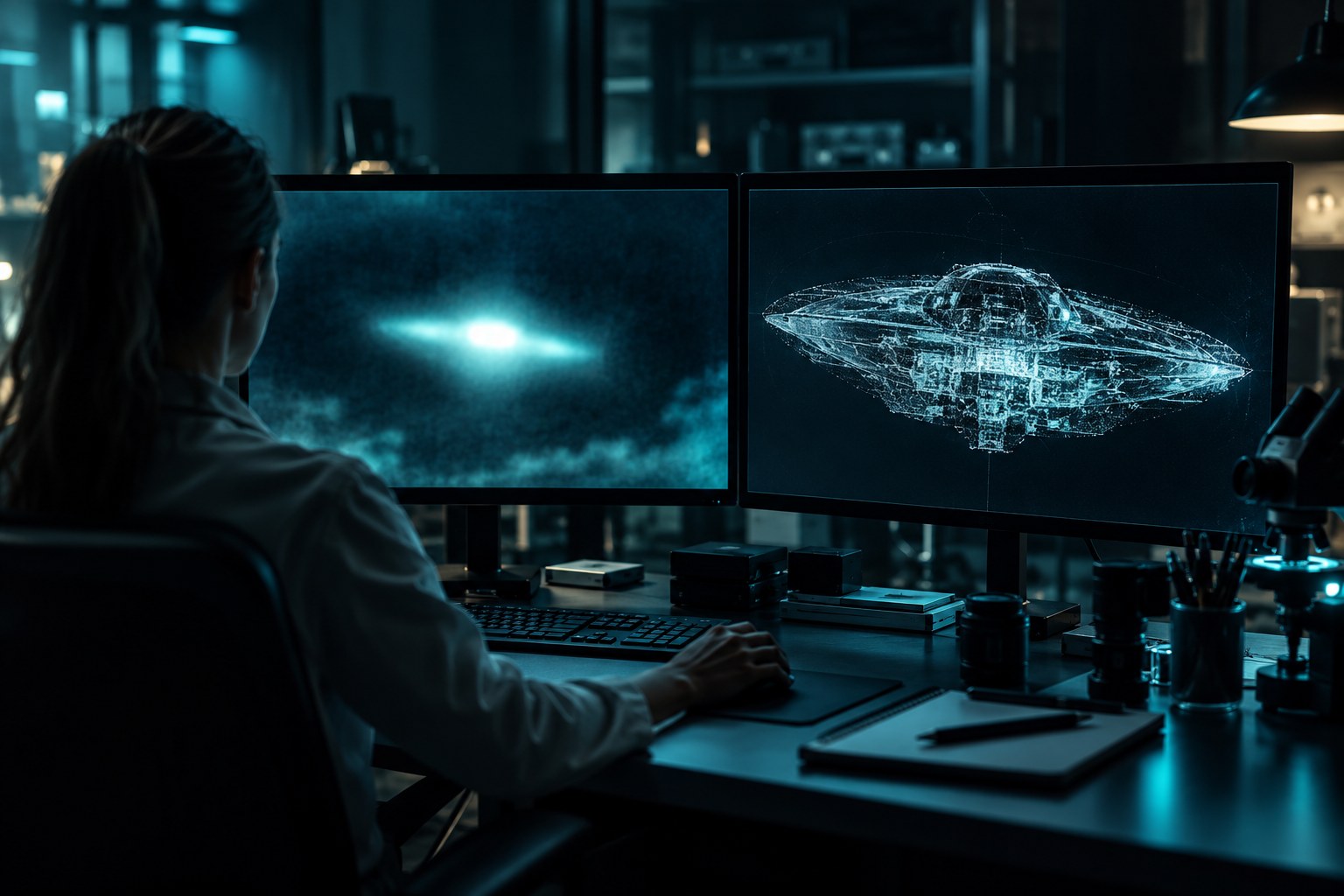
Two mysteries in one clip
The “floating brain” nickname is memorable because it gives an ambiguous shape a familiar identity. Coverage in July 2026 discussed a released UAP video and an AI-enhanced version circulating online. [1] That creates two different questions: what did the original sensor record, and what did the processing add? Combining those questions is how an intriguing clip becomes a much stronger claim than the evidence supports.
Sharper does not always mean truer
Research on image restoration describes a tradeoff between perceptual quality and fidelity, and later work examines hallucinations in generative restoration. [2][3] In plain language, a model can produce a convincing-looking detail that is not recoverable from the input. A ridged surface, a sharp edge or a symmetrical feature may be visually plausible without being a measured property of the object. The enhancement must therefore be treated as a processed interpretation.
Motion needs its own audit
A claim about sudden acceleration needs more than an exciting replay. Ask whether the sequence was stabilized, slowed down, interpolated or generated between frames. Ask whether the camera moved and whether the original timestamps survive. An edited clip may help someone inspect a question, but the claimed maneuver should be demonstrable in the unaltered recording. This article does not claim to have performed a forensic analysis of the original footage.
What a fair comparison would show
A useful side-by-side should begin with the original source, then name the software, settings and every processing step. It should use matching frames at matching times, with a permanent label identifying the altered version. If the alleged detail disappears when the enhancement is removed, that is a reason to investigate the processing—not a reason to call the detail confirmed. A downloadable original is more valuable than a dramatic before-and-after animation without provenance.
Keep the spectacle in its lane
There is nothing wrong with enjoying a strange image. The problem begins when an illustration or reconstruction is promoted as recovered evidence. Our cover is explicitly an AI-created concept image, not a frame from the Pentagon video. That distinction is the point of this story: the most impressive image in the thread may tell us more about the software than about the sky.